The complete tour
How it works, in full.
Pawservation is a booking page that lives on your own website, showing your services, your rates, and only the dates your rules allow. You stay in control of all of it — every request arrives as a request, and waits for you.
Everything below is built and working today. Where something isn’t, it says so. The demo is a made-up sitter’s account — nothing to sign up for, none of your own details asked for, nothing you can break.
Five kinds of service, each with its own rules
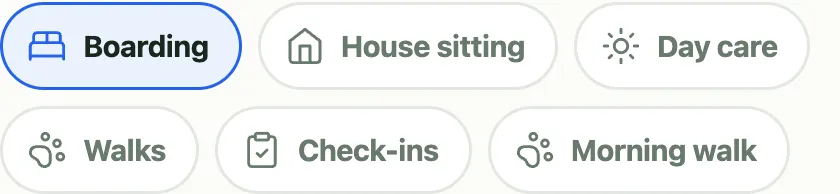
Every service you offer starts from one of five templates. The template decides how dates are chosen and how the price is counted; everything else — the name, the rate, the limits — is yours.
Boarding · per night
Overnight stays at your place, over a range of dates. Set the most pets you’ll keep at once and the longest stay you’ll accept. There is no minimum stay to set: one night is the shortest thing anyone can ask for.
House sitting · per night
You stay at the client’s home, again over a range of dates, under its own cap. And because you can’t be in two places at once, house sitting and boarding are held apart — by however much you say (see below).
Daycare · per day
Daytime care at your place, priced per day. Clients pick single dates rather than a stay, so a Tuesday and a Friday are two separate bookings.
Walk · per walk
Priced per walk, with options that carry their own length and time window — a “Morning 30” and an “Evening 30” can sit side by side at different prices.
Check-in · per visit
Drop-in visits — feed, let out, top up the water — with the same per-option lengths and windows as walks.
Anything you call your own
A custom service clones one of the five, so a “Morning walk” behaves exactly like Walk under your name and your price. New services can’t invent behavior the calendar doesn’t understand.
What you set on each one
A rate in whole dollars, in a unit you can’t get wrong.
The unit belongs to the service, not to the price box: boarding is per night whether you charge forty or ninety-five. The number and the word printed beside it come from the same place, so they can never drift apart.
Options, each with a length and a fixed window.
A thirty-minute walk between 10 and 2 is one option; the same walk between 4 and 6 is another. Clients pick the option, not an arbitrary time, so you’re never booked at 6am by accident.
A per-day limit on each option.
Say your morning pack walk takes eight dogs and your solo walk takes one. Book eight dogs onto Tuesday’s pack walk and Tuesday stops being offered for the pack walk — the solo walk still shows until its one spot goes. Each option fills up on its own, date by date, and it counts animals rather than bookings: with one place left, a household bringing two dogs isn’t offered that day either.
Weekdays only, where that’s the truth.
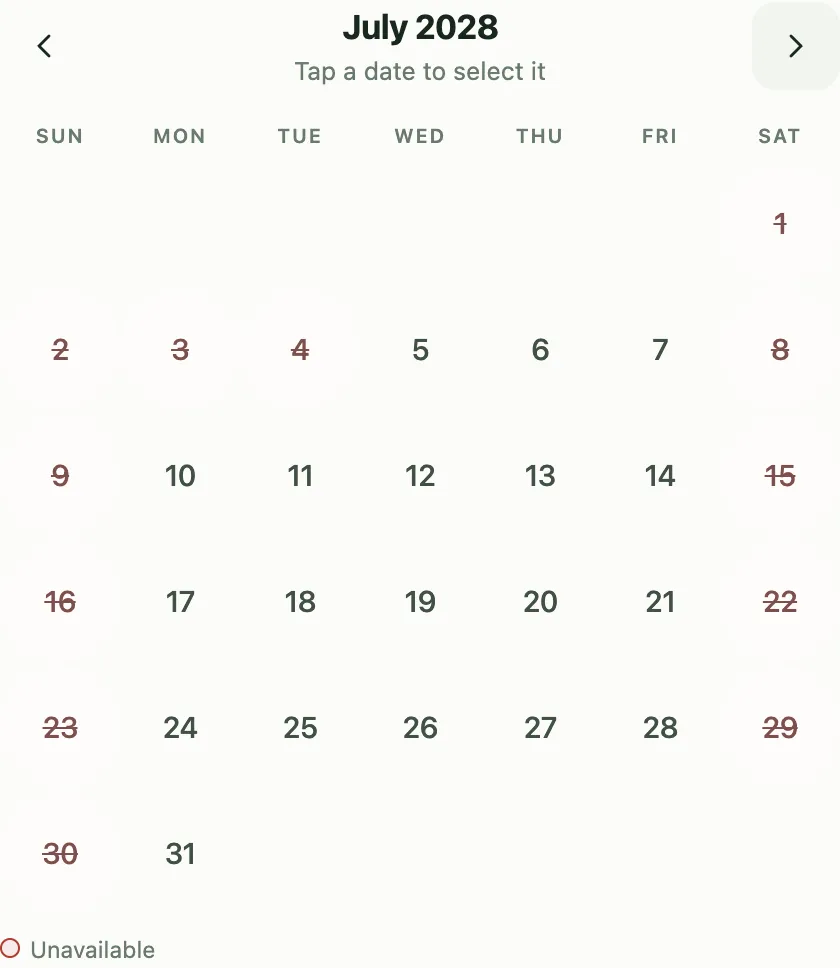
Mark an option weekdays-only and its weekends are struck out in the calendar rather than quietly accepted and then declined.
The longest stay you’ll do.
For the per-night services, set a maximum number of nights and a request longer than that never gets as far as your queue. There is deliberately no minimum: a stay is at least one night by its nature, so there was nothing honest for that box to do.
How much notice you need.
Set the days of notice a service needs and everything sooner than that is struck out. Two days on boarding means the earliest a client can ask for is the day after tomorrow — so “can you take him tonight?” stops being a question you have to answer. Leave it blank and same-day is fine.
One thing that isn’t here yet: a repeating schedule.
Every visit is its own request today — a client who wants a walk every Tuesday picks each Tuesday. There is no “repeat weekly” to set, for you or for them.
The limits you set are the limits clients see
None of this is advisory. A day you can’t take isn’t offered, and an animal you don’t accept can’t be chosen.
The dials you get
Caps count pets, not bookings.
If you’ll take three at a time, one booking for three dogs fills the day by itself — three pets, three slots — and the calendar strikes that day out for everyone else. That is the whole point of counting animals rather than requests.
Only the animals you actually take.
Accepted pet types are set per service, so you can board dogs and do check-ins for cats without accidentally agreeing to board the cat. Each new service starts from the likely answer rather than from nothing — walks and daycare start dogs-only, check-ins start cats-only, boarding and house sitting start open to everything — and you re-tick the boxes if your business is different.
Where you physically are, when boarding meets a house sit.
You can’t sleep at a client’s house and keep a boarder at your own, so the two are held apart, and you say by how much: never overlap, one handover day (the default), one handover day at each end of a stay, or no limit if you’d rather sort clashes out yourself. A shared day only ever counts as a genuine handover — one thing ending as the other begins. A boarding dropped into the middle of a house sit is refused however high you set the number, because no number makes that possible.
How far ahead anyone can book.
One setting for the whole business: months out, and beyond it the calendar simply stops. New accounts start at twelve months, so nobody books your Christmas two Christmases early. Clear it and there’s no horizon at all.
Your questions, asked at booking time.
Write your own intake questions — medications, the gate code, which vet, anything you always end up asking — and they arrive answered, with the request, instead of over six texts on the day. A regular’s answers come back already filled in the next time they book that service, so nobody retypes the gate code every month; reword the question and the stale answer is dropped rather than pre-filled.
Time off, in whole days.
Mark a day — or a run of days — as time off and it simply stops being offered, struck out for every service, walks and check-ins included. Away next Tuesday? Block Tuesday and nothing else changes. Time off is whole days only: there is no way to close just the 10am walk and keep the rest of that day open.
Cancellation fees in your own windows.
Set up to five windows, each a percentage of the estimated cost. When a client cancels, the tightest window that applies is the one that wins. Leave it blank and there’s no fee at all — the policy is only what you wrote. The client cancels from the booking page and the fee is worked out here, from your stored policy, and recorded as owed — they never get to name the figure, and you never have to do the arithmetic in a difficult conversation. A request you hadn’t confirmed yet is always free to withdraw.
Invite-only, and pending until you confirm
There is no public sign-up and no directory. Your client list is a list you built, and a booking is a request until you act on it.
Step by step, from your client’s side
-
01
You add the client first. Nobody who isn’t on your list can book. Add clients one at a time, or import a CSV — an example file shows the columns to copy.
-
02
They sign in with a code. No password to invent, forget, or reset. They type the email you invited, a code arrives, and they’re in. Co-owned pets work the way households actually do: a dog can belong to two people, and both can book for it.
-
03
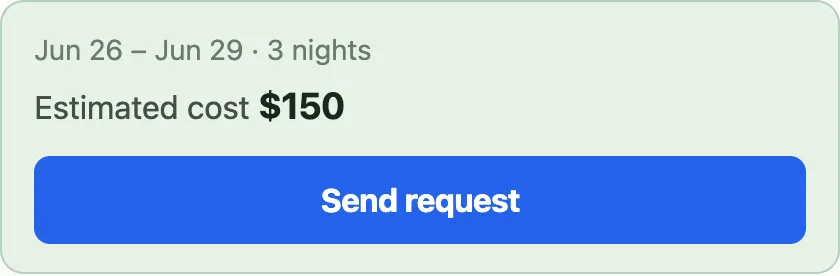
They pick a service, then dates. The widget offers only what you’ve set up, only where your rules allow it, and it knows which animals they’re bringing while they choose — a day with one space left is struck out for a two-dog household rather than accepted and then refused. The nights and the price sit next to the button before they press it. That price is worked out by Pawservation itself, so the page can never show one number and charge another — the figure your client is shown is the figure the booking is stamped with.
-
04
You confirm, or you decline. Every request is pending until you confirm it, and nothing gets confirmed on its own. A request does land on your calendar straight away, but the event title starts with
[REQUEST]until you act, so a maybe never looks like a yes. Declines and cancellations stay on the record rather than disappearing, so the history of what was asked still reads straight months later. -
05
They change it or cancel it themselves — without texting you. New dates, a different pet, a different arrival time, a corrected answer: they edit their own booking on the same page they made it on. What they cannot change is which service it is — a boarding does not quietly become a house sit. Because you agreed to specific dates for specific animals, an edit to a confirmed booking comes straight back to you as pending, and you re-approve it or decline it like any other request. Rescheduling is not cancelling, so an edit never charges a fee. Every rule that applied when they booked applies again to the change, so an edit can’t squeeze past a cap the original request respected.
-
06
A cancellation reaches you as an email, with the number already worked out. They cancel, your policy decides the fee, and you get a message saying which it was and whether anything is owed. Nothing is deleted: the booking stays on the record as cancelled, and a fee that’s owed shows up in what’s outstanding like any other money. Even a stay already under way can be cancelled — refusing would only push the conversation back onto your phone.
You collect it your way — Pawservation keeps the count
The arithmetic is deliberately boring: your rate, times the nights, days, walks, or visits booked — and, on the setting you pick, times the number of pets. Nothing enters the sum that you did not choose.
How the counting works
You choose what a second pet does to the bill.
Every service carries one setting, in plain English. Either two dogs cost twice your one-dog rate, or only the combinations you have priced can be booked together. A service you add starts on the first, so a two-dog household can book the moment you type one price; switch it to the second and a pair you have not priced is refused rather than guessed at. Whichever you pick, a second pet also uses a second slot of your capacity, and the figure a client sees traces back to a choice you made — there is no third behaviour we picked for you.
Record payments as they land.
Cash, Venmo, Zelle, PayPal, check, card, or something else entirely. Log as many part-payments against one booking as it takes — a deposit now and the rest later — each with its own date and note.
Paid on Venmo? Upload the CSV.
Download the CSV Venmo gives you for a month and drop it into Earnings. Pawservation reads the payments that came in, lines each one up with the client who sent it by their Venmo name, and shows you every match before anything is recorded — you approve what’s right and fix what isn’t. The file is read in memory and never stored, and uploading the same one twice records nothing twice.
Pawservation records payments. It never processes them.
The money goes from your client to you by whatever means you already use. Nothing routes through us, so there is no cut taken and no fee on your earnings. An earnings view totals up what you’ve recorded.
Two dogs can cost more than one — and you decide how much more.
Price a combination and that combination has that price, whichever setting the service is on. On your walk, one dog might be $40 and two dogs $60 — two numbers you typed, and they beat the doubling every time. Set them once per service and they apply to every client. A group with no rate of its own falls to the setting you picked: either your rate for each pet, or the widget asks you for a rate before it will book them. There is no third answer invented in between.
One client can keep an old price.
Tina and Rob have walked Fido with you since before you raised your rates, and you’d rather not raise theirs. Put a $20 walk on Fido’s account and Fido’s walks stay $20 while everyone else’s are $40. A rate on a specific animal wins over a rate for “two dogs”, which wins over your ordinary rate for the service — so the narrower promise is always the one that holds.
Bookings turn up where you already look
Connect Google Calendar once and your week keeps living in the place you already check twenty times a day.
Pending and confirmed, both
A request becomes an event the moment it arrives, not only once you’ve said yes — so a busy week looks busy before you’ve made up your mind.
The whole booking, in the event
Service, dates, times, the pets by name, the estimated cost, and the client’s email address — enough to answer from your phone without opening anything else.
Nothing dead looks alive
Decline a request, or cancel with nothing owed, and the event is removed. A cancellation that carries a fee keeps its event and retitles it [CANCELLED] instead — the dates are free again, but money you’re still owed doesn’t vanish out of your week.
Optional, and skippable
Skip it during setup and everything else works exactly the same. Connect months in and everything still upcoming is added to your calendar then — nothing you booked before connecting goes missing.
Your Google connection is stored encrypted
The credentials that let us write to your calendar are stored encrypted, and you can disconnect whenever you like.
It reads your calendar, too
Bookings flow out to the connected calendar — and busy events you keep there flow back. Add a stay by hand in Google and Pawservation blocks those dates automatically; move or delete it and the block follows. Every other calendar in your account is never read and never touched.
If Google is down
Your dashboard is the record; the calendar is a mirror of it. If Google can’t be reached, the booking still lands in Pawservation, and a background sweep keeps retrying until the event lands in Google too. Worst case, the mirror lags a few minutes — it never loses a frame.
One line, on the site you already have
Paste the script line into a page on Squarespace, Wix, or plain HTML, swap in your slug — the short name in your booking page’s web address — and save. The widget measures itself and tells the page how tall to be, so it never sits in a box that’s too short.
If your host strips scripts — Wix’s “Embed a site” is the usual culprit — use the iframe version underneath instead. Same widget, fixed height, no JavaScript on your side.
Not the person who edits your website? Forward this box to whoever is — it’s one line, and it’ll take them under a minute.
<script src="https://your-site/embed.js" data-pawservation-tenant="your-slug" data-height="520"></script>
<iframe src="https://your-site/embed/your-slug" title="Booking widget" style="width:100%;height:640px;border:0;"></iframe>
Four steps, none of them destructive
The wizard gets you from an empty account to a working booking page in one sitting, and it only ever adds — run it again and it won’t undo what you set.
What each step asks you for
-
01
Your business. What you’re called, how clients reach you, your brand color, which timezone your dates are in, and how far ahead people may book (twelve months to begin with).
-
02
What you offer. Seven one-tap presets, each a whole service already shaped — “Group walks · weekdays 10–2 · up to 8 pets” is one tap, windows and limits included. Tap the ones that describe you.
-
03
Your prices. Whole dollars, with each service’s own unit printed beside the box. Times and limits come prefilled, and anything can be changed later.
-
04
Your calendar, if you want it. Connect Google Calendar, or skip it — skipping costs you nothing else, and you can connect from Connected apps whenever.
What about the stays you’ve already agreed to?
Straight answer: you can’t type an old booking in yourself. But if the stay is already on the calendar you connected, you’re done — Pawservation reads that calendar and blocks those dates automatically, so nothing can be double-booked over it.
Want the stay tracked properly — caps, records, what you’re owed? Have the client send the request through your booking page. It takes them a minute, and then your calendar and your books match reality.
The plumbing for what comes next is already in
You can skip this section — it’s for the software your clients might use, not for you. It’s groundwork, laid early because retrofitting it later is how booking systems end up double-booking people.
A “no” that says why
A refused booking answers with a fixed code as well as a sentence, so other software can understand a “no” and say why — “those dates are full” and “that stay is too long” are told apart without guessing at the wording.
Sent twice, booked once
A request can be tagged by whatever sent it. If a shaky connection sends the same request twice, only one booking is created — the second attempt gets the first booking back rather than making a second.
Your services, written out plainly
Your booking page publishes a plain-text summary of what you offer and how to request it, so automated assistants can read your rules instead of scraping the page.
That’s the whole thing. Want in?
Pawservation is invite-only while it grows. Ask, and we’ll set up your services, rates, and booking page — taking bookings is free, and stays free. Or just poke at the demo first: it’s a made-up sitter’s account, nothing to sign up for, none of your own details asked for, nothing you can break.